“If you think of Higharc as just a drafting tool, you’re only taking a sliver of the value." - Philip Lemperle, VP of Product
.png)

Legacy South is a Nashville-based homebuilder focused on delivering thoughtfully designed homes with modern style, quality craftsmanship, and a personalized experience.
Tennessee, Nashville
Company size:
2013


Growing fast in a market that demands precision
Legacy South is a privately held homebuilder rooted in Nashville. Unlike national builders with multiple layers of approvals, they operate with a tight leadership team and the ability to make decisions quickly.
Legacy South has built a reputation for delivering personalized homes across the Nashville market, combining thoughtful design with the speed of a locally led organization.
That agility has become a competitive advantage.
But as the company expanded toward ten active communities and launched new product lines, leadership recognized something important:
Speed without alignment creates friction.
“We can make decisions quickly,” said Jessica Martin, Director of Sales. “But if information doesn’t move just as quickly through sales, drafting, and operations, that’s where problems start.”
In a shifting market where buyers are more selective and margins require discipline, Legacy South knew efficiency couldn’t live in just one department. It had to be systemic.
When growth introduces complexity
Legacy South has always differentiated through personalization. They are not a custom builder, but they offer meaningful structural and finish options that allow buyers to reflect their personality in the home.
As the company grew, that flexibility also introduced more complexity to manage across teams. Structural options needed coordination across departments. Design selections required dedicated appointments with buyers. Plan updates and lot-specific variations were often handled in separate files.
On the drafting side, producing lot-specific construction documents could take anywhere from 30 minutes to several hours depending on the number of selections.
On the sales side, pricing and personalization required more coordination than leadership wanted as the company scaled.
“Before Higharc, it was a little more antiquated,” Martin explained. “You’d sit down, pull out the addendums, and go line by line. It took longer, and it wasn’t as visual for the buyer.”
As the market normalized in Nashville, Legacy South saw an opportunity to tighten internal processes before the next phase of growth.
Replacing static plans with a configurable foundation
Legacy South did not treat Higharc as a simple drafting replacement.
Philip Lemperle, VP of Product, approached it as a broader product management decision.
“If you think of Higharc as just a drafting tool, you’re only taking a sliver of the value.”
Instead, the team viewed Higharc as a way to centralize product information and better align how plans move through the business.
Previous workflow:
- Multiple Revit versions per plan across communities
- Manual hiding or deleting of unselected options
- Lot-specific plan sets built by copying master files
- Version history difficult to track
With Higharc:
- One centralized studio file per plan
- Conditional logic controls options
- Lot-specific construction documents generated instantly once selections are finalized
- Version history documented and traceable
“In Revit, we’d save a copy, rename it to the lot, and manually adjust options,” said Senior Draftsman Coleman Ladd. “In Higharc, once the selections are locked, the CDs are instant.”
That shift allows the drafting team to spend less time managing files and more time focusing on design intent.
From learning curve to leverage
Adopting Higharc required a shift in mindset.
Drafting in Higharc differs from traditional Revit modeling, and early on the team had to retrain how they approached plan creation. There were also questions about how early design decisions would affect downstream processes like procurement and estimating.
Hands-on training and collaboration with Higharc’s implementation team helped accelerate the transition.
“We weren’t stranded,” Lemperle said. “The support was there. That matters when you’re implementing something that touches every part of your organization.”
Once standards were defined and plan logic structured correctly, the advantages became clearer. New plan sets could be developed more quickly, updates remained consistent across versions, and structural options could be managed without duplicating entire plan files.
Faster sales conversations, stronger buyer confidence
While operational improvements were meaningful, the impact on the sales experience was immediate.
Today, Legacy South’s sales counselors can:
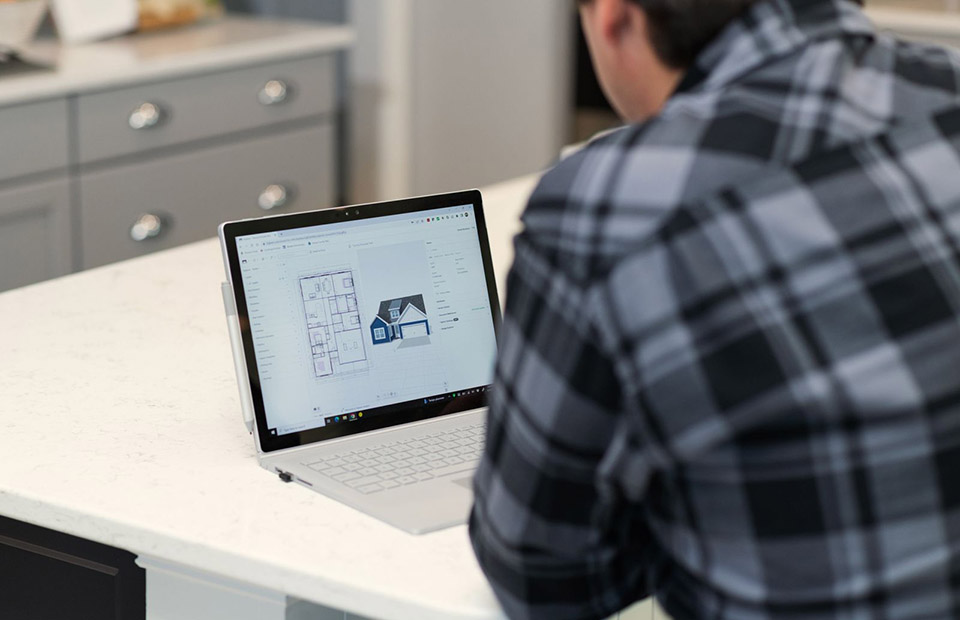
- Configure homes live with buyers
- Show structural changes in 3D
- Display cabinetry, layouts, and elevations visually
- Generate a personalized brochure with pricing during the first visit
For pre-sales, this capability is especially valuable.
“We’ve had buyers in the past ask for a 3D walkthrough of layouts that weren’t in a model,” Martin said. “Now with Higharc Showroom, we can show them.”
Selling homes before a physical model is built becomes far less risky when the visualization accurately reflects the construction documents behind it.
“The process is so easy you almost think you’re making a mistake,” Martin said. “But you’re not.”
That clarity helps reduce one of the most common sources of frustration in homebuilding: the gap between what buyers think they are getting and what ultimately gets built.
Buyers can revisit their configuration later, explore different options, and better understand how their selections affect the final home. In a market where many buyers are moving for emotional or life-stage reasons, that confidence becomes an important part of the sales process.
Accelerating a new market launch
Legacy South recently entered a new Tennessee market through its Banner Built Homes brand.
Like many new market launches, early traction took time. From October through December, the community recorded no sales.
Rather than waiting for sales momentum to build, the team adapted. Using Higharc, the team developed and launched three new plans in one month, fully designed, configured, and ready for buyers.
The result was immediate.
Three pre-sales in the first month with the new plans.
In a new market entry, that shift matters. Higharc allowed the team to move from concept to sales-ready plans quickly, enabling them to sell pre-construction homes without waiting for model homes to be completed.
A system that moves at the same speed as the business
One of the biggest shifts Legacy South’s leadership describes is internal alignment.
Product changes that once required coordination across separate systems can now move through the organization more quickly.
That speed requires disciplined communication, but it also reduces the risk of outdated plans circulating across teams. Sales, drafting, and operations now work from the same underlying plan data.
And in a competitive Nashville market filled with large national builders, that agility allows Legacy South to:
- Maintain personalization
- Improve internal efficiency
- Launch new product faster
- Operate without adding unnecessary overhead
Results and reflections
Legacy South is still evolving its Higharc implementation, particularly as procurement integration deepens and new product lines expand.
But the early results are already clear. Lot-specific plans can be generated instantly once selections are finalized, drafting teams spend less time managing versions, and sales teams can guide buyers through decisions with greater clarity.
“We’re trying to build a better product experience for our customers,” Lemperle said. “And Higharc gives us the structure to do that.”
For a builder that values speed, personalization, and local decision-making, having that structure in place makes growth easier to manage.

.png)
.png)






.png)