
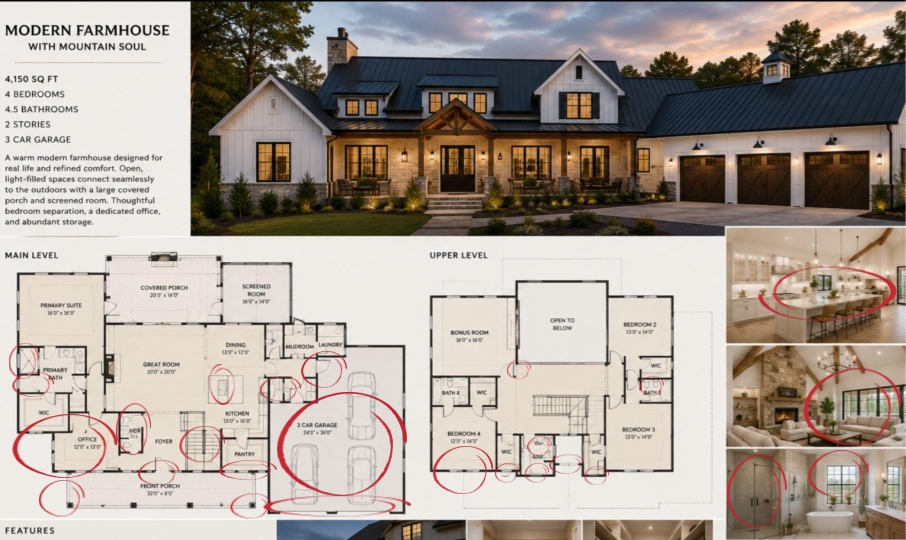
AI has changed the way we interact with words, code and data. But homes aren't made of words. A floor plan isn't a sentence. A load-bearing wall isn't a paragraph. No one has uploaded the moment a superintendent looks at a set of drawings and knows the staircase is going to be a problem. That knowledge doesn't exist anywhere that an AI model can reach it. It lives in experience, decisions, and decades of builder knowledge.
And that’s why general-purpose AI falls short in homebuilding. AI can work with enormous amounts of information, but much of what builders rely on to design and build homes isn’t available in a form they can accurately interpret.
Did AI forget about homebuilding?
We've all heard the pitch by now. AI is going to solve everything — and if it hasn't solved your problem yet, just wait. Don't upgrade your systems. Eventually, AI will just do it for you!
The problem with that advice is that LLMs generate words and code, but to be useful in homebuilding, AI needs the data infrastructure to solve complex spatial problems and the inputs homebuilders actually need to build homes at scale. That sounds straightforward until you consider the stakes. An AI hallucination in a blog post is an embarrassing typo. A hallucination on a construction site is a change order, a backcharge, a damaged relationship with a customer or a vendor. Suddenly the AI you tasked with streamlining is costing you time and money. In the built environment, "close enough" isn't a rounding error: it's a rework cycle.
That's why spatial AI can't be built the same way language AI was built: by scraping a wide range of data from the internet. It requires something much harder to obtain: decades of hard-earned knowledge by talented architects, real-world project feedback and a deep understanding of physical constraints.
Much of the knowledge required to coordinate and build a home across design, estimating, sales and construction — such as company-specific standards, relationships and accumulated operating knowledge — isn't in any textbook or database. It lives in the unwritten rules experienced builders have developed over generations — how design decisions impact schedules, how lot constraints determine option availability, how a change on one drawing should, but rarely does, automatically propagate everywhere it matters. Do you have an SOP that explains what a dashed line means on a construction set? Of course not, but AI doesn’t have the context your people do.
Why traditional home plans are so hard for AI to interpret
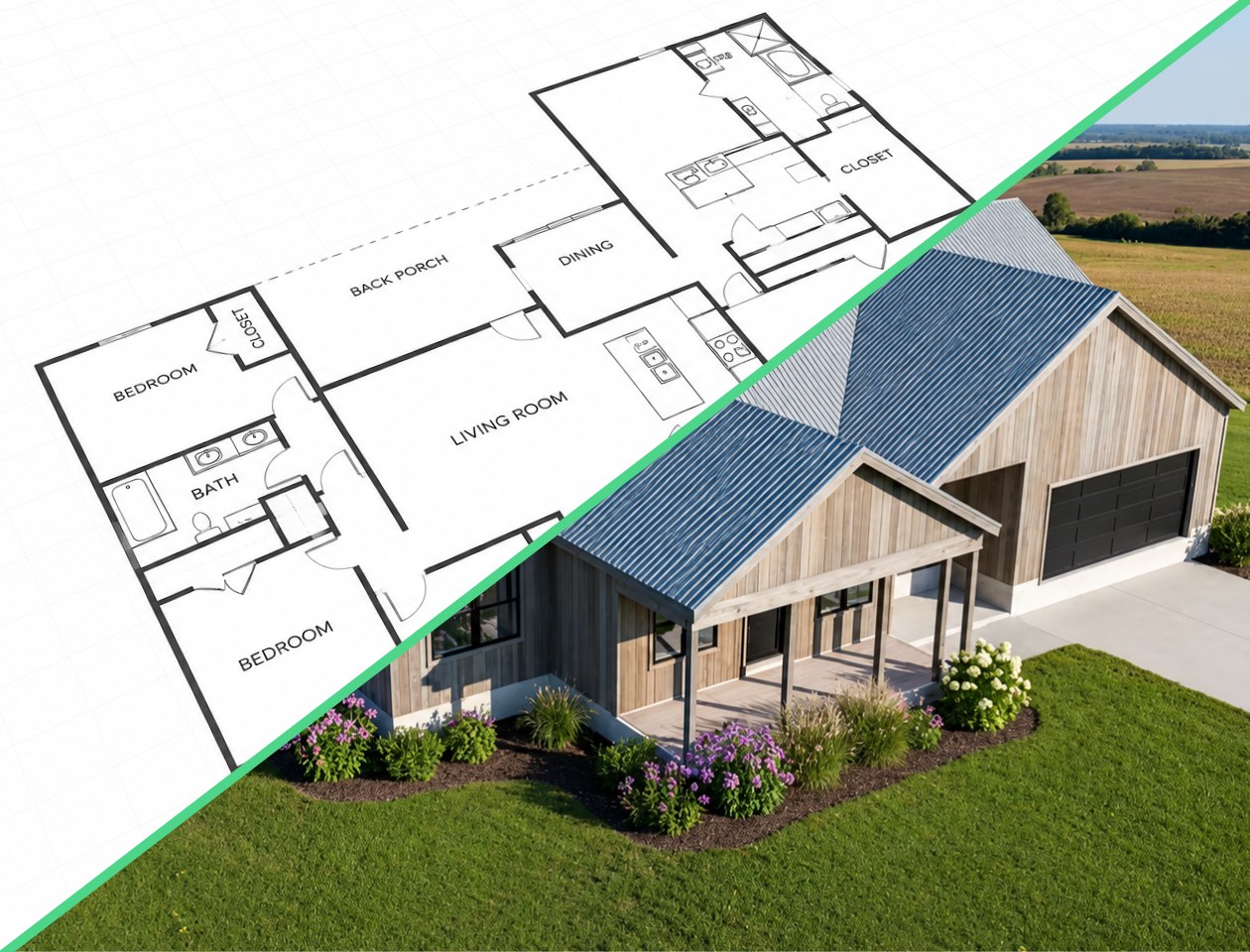
For decades, homebuilding has run on static drawings in systems like AutoCAD. These systems produce PDFs, CAD files and drawings that are mostly just lines. They contain tremendous knowledge, but they don’t tell an AI system what each element represents, how the elements relate to one another or what else should change when one of them changes.
When AI looks at a traditional homebuilding workflow, it sees what a new employee sees on day one — a pile of disconnected documents with no shared source of truth. General-purpose AI tools can discuss homebuilding theory fluently. They've read the textbooks. But they struggle to operate in an actual homebuilding environment because the knowledge in those drawings isn’t structured in a way they can interpret with construction-level accuracy. They don’t have the homebuilding intelligence.
So what is homebuilding intelligence?
Homebuilding intelligence means understanding that moving a wall two feet changes the structural load, material takeoff, buyer options, sales collateral, construction documents, cost and pricing — all at once. It means knowing that a 40-foot lot width constrains your garage configuration, which constrains your elevations, which constrains your margin. It lives in the institutional knowledge of the people in the homebuilding industry. YOU may know this. AI, in many cases, does not.
Examined from a workforce perspective, this becomes even more urgent. NCCER research shows that 41% of the construction workforce is projected to retire by 2031, while Home Depot’s Living our Values Report states that 4.1 million construction jobs will need to be filled by 2035. A significant portion of that hard-earned institutional knowledge will disappear with the people who carry it. The productivity gap is coming whether the industry is ready or not.
AI will only earn homebuilding's trust when it produces construction-ready outputs that satisfy building codes, respect physical constraints and account for real-world complexity — without requiring a human to spend hours correcting them after the fact. In homebuilding, precision is the price of admission, not the differentiator.
How Higharc leverages AI in homebuilding
Higharc was built for exactly this challenge — not as a feature bolted onto an existing tool, but from the ground up, for residential construction, by people who have been there and done that.
Where legacy platforms treat a home as a collection of drawings, Higharc treats it as a living data model. Every element is three-dimensional and generative — Higharc knows what it is, what it connects to, and what changes when something else changes. It's not a picture of a home; it's a data model of one. This system turns a plan change from a round of redlines into a system update. Plate heights, roof pitches, foundation types, trim sizes — changes that would otherwise require updating every version of every plan can be made in a few keystrokes and propagated everywhere they belong.
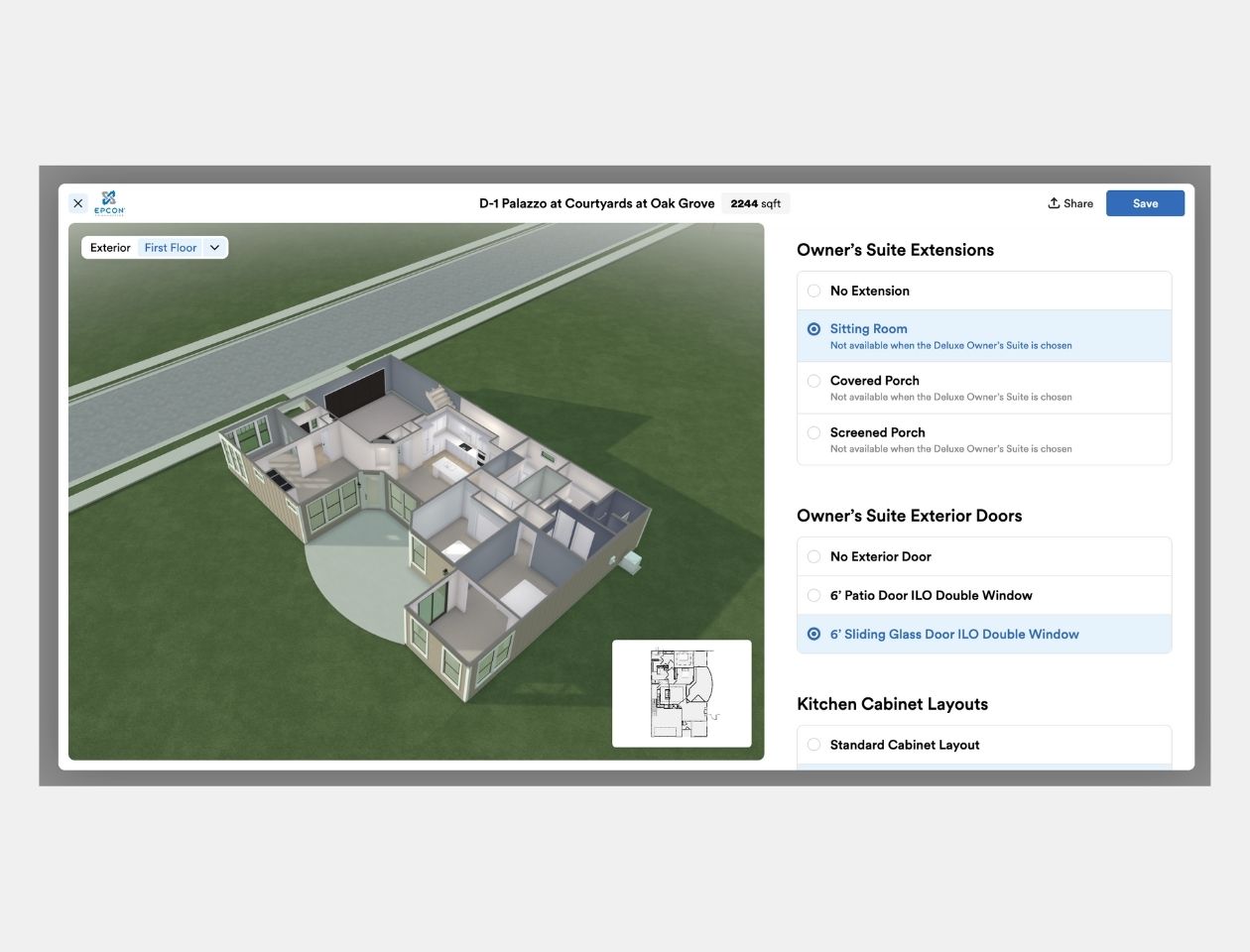
When a plan is updated, every downstream document updates automatically: construction drawings, material takeoffs, sales configurator and cost estimates. When a buyer selects an elevation, a garage orientation and a structural upgrade, the model already knows the cost of that combination, what it looks like in 3D and which documents are needed for permitting.
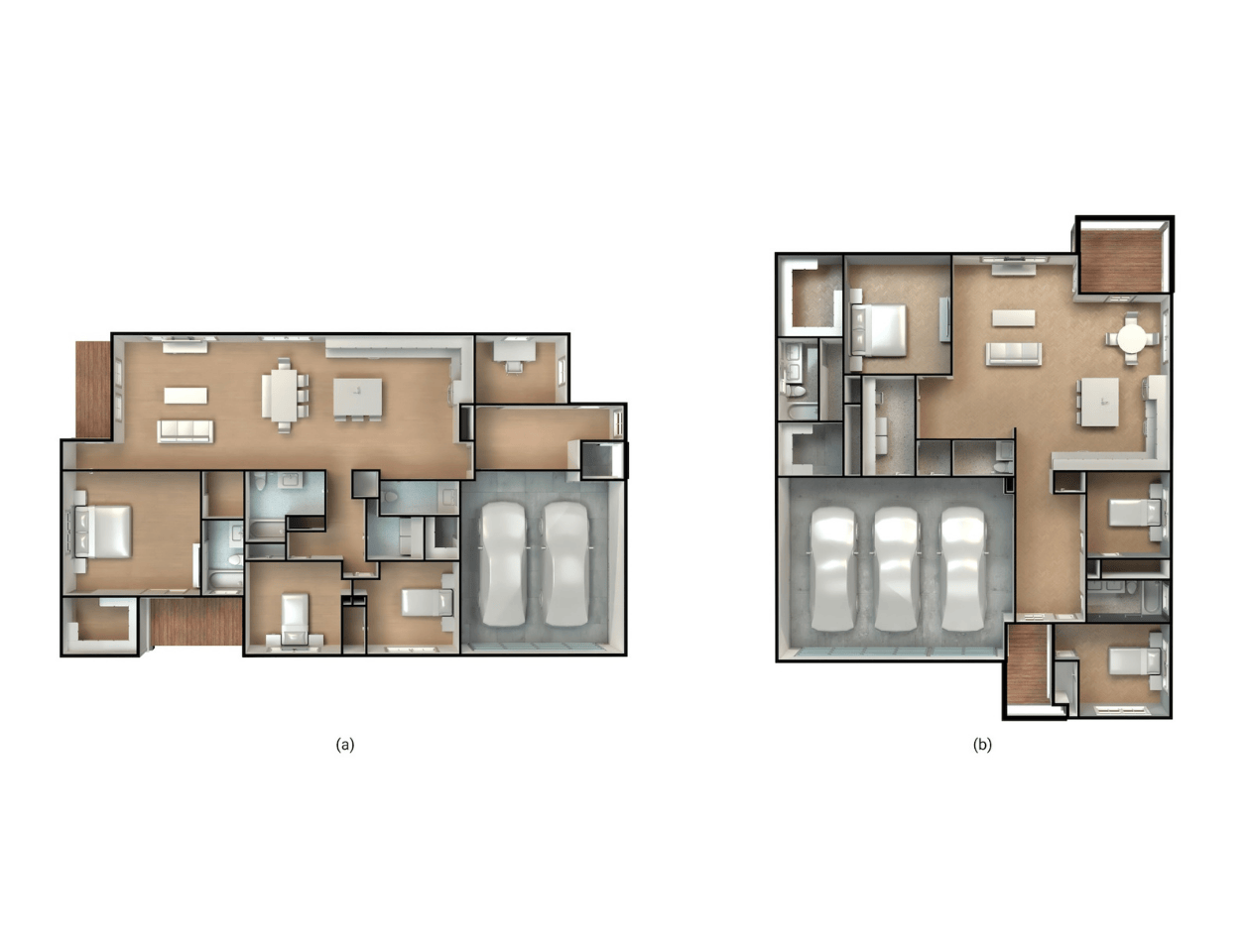
That’s the difference between AI that talks about homes and AI that works on them. Don’t believe me? "The kitchen is 12 feet by 14 feet" sounds simple, but generating a drawing where that's actually proportionally accurate — where the island fits, where the refrigerator door clears the island, where the flow makes sense for the way a kitchen is used — is a precision problem that general-purpose LLMs routinely fail. Not because they're not powerful, but because they weren't built for it.
Higharc: the homebuilding AI platform that works
Capturing builder knowledge and making it work requires more than giving an LLM a clever prompt. It requires a platform that can structure homebuilding intelligence around the home itself and use it to produce construction-ready outputs.
That platform exists. It's already working for production builders today. You don't have to wait for AI to figure out homebuilding — because Higharc already did.
Frequently asked questions
See Higharc in action
Discover how Higharc can empower your team to conquer change, modernize your buyer experience, and decrease cycle times.
Book a demo
.png)




.png)
%20(1260%20x%20960%20px).jpg)



.png)


.jpg)


%20(1260%20x%20960%20px).jpg)

.jpg)

.jpg)


