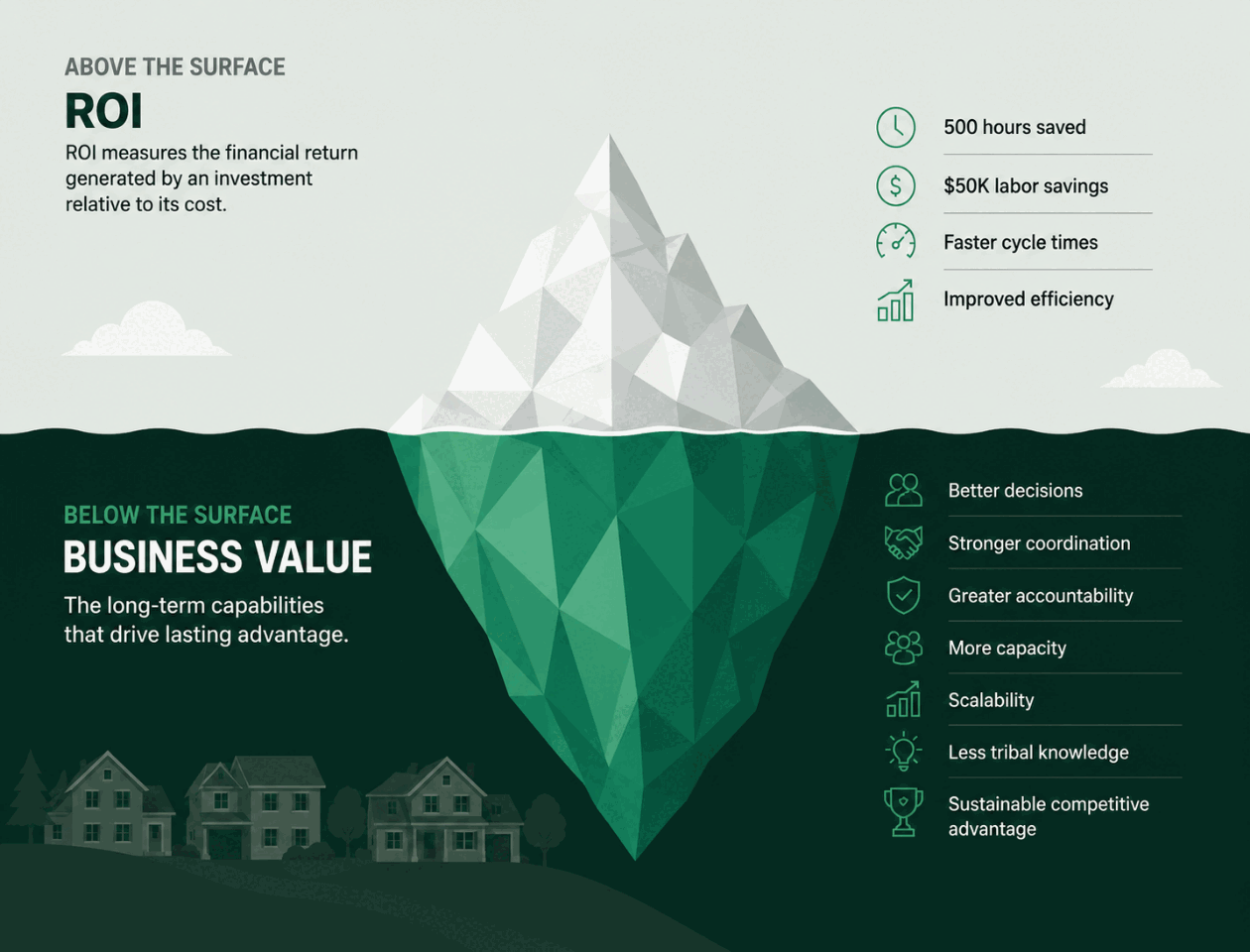
ROI shows the immediate financial return from homebuilding software. Business value reveals the long-term capabilities the investment creates.
Ed Kubiak
Lead Customer Success Manager, Higharc
Homebuilding Professional • 2x VP of Construction • Mentor NextGEN Builders • Former Pulte
ROI may help you win this quarter. Business value is what helps you win for the next 10 years.
During nearly every software implementation I’ve been part of, someone from finance eventually asks for an ROI analysis. They expect something quantifiable, like $40,000 in savings due to more efficiency or lower labor costs.
But there’s something else to keep in mind when assessing software, and that’s business value. Business value considers what the investment enables the company to do over time. For example, the software might offer a homebuilder better visibility into operations and, as a result, improve decision-making.
Key takeaways
1
ROI measures the financial return generated by a software investment.
2
Business value includes the long-term operational capabilities the investment creates.
3
Better coordination, stronger decisions and greater capacity may be difficult to capture in an ROI calculation.
4
Homebuilders should evaluate measurable returns and operational capabilities before investing in software.
An ROI example
A software implementation might deliver the following ROI:
Reduced cycle times
Fewer manual entries
Less administrative labor
Improved purchasing efficiency
Higher sales conversion rates
Automated drafting saves 20 hours a week. Easy to measure.
A business value example
The same implementation allows construction, purchasing, sales and customer care to operate from a single, shared source of truth. The value is harder to measure, but far greater.
Why? Because:
Decisions become more strategic
Accountability improves
Trust increases
Silos break down
Leaders spend less time resolving conflicts
In addition to the software saving time, it changes behavior and creates a lasting advantage.
How to evaluate a technology investment
When evaluating a technology investment like homebuilding software, ask two questions:
What measurable return will this create?
Cost savings, revenue gains, reduced labor and shorter cycle times all contribute to ROI.
What new capability will this create?
Better decision-making, greater transparency, faster onboarding, stronger leadership, a more consistent customer experience and the ability to scale all contribute to business value.
ROI without a meaningful operational benefit warrants closer scrutiny, while an investment that creates a valuable capability may still deserve support, even if its immediate financial return is difficult to quantify. However, a solution that delivers both ROI and business value is a win-win that deserves serious consideration.
The business value of homebuilding software
Imagine a homebuilder implements software that automates purchase orders.
The ROI calculation might show:
500 hours saved annually
$50,000 in labor reduction
Great! And the larger business value might be:
Purchasing managers spend those hours developing trade relationships
Field leaders spend more time coaching assistants
Future leaders gain visibility into operational metrics
The organization becomes less dependent on tribal knowledge
These changes determine whether the initial efficiency gain becomes a lasting operational advantage.
Business value can outlast the initial ROI
In homebuilding, ROI helps justify a technology investment. The capabilities created through that investment determine how much value remains after the initial savings have been realized. And the companies that will thrive over the next decade will be those that use technology to elevate people, strengthen leadership, and build capabilities their competitors can't easily replicate.
Frequently asked questions
ROI and business value FAQs
What is the difference between ROI and business value?
ROI measures the financial return generated by an investment relative to its cost. Business value includes the operational capabilities the investment creates, such as better coordination, faster decisions and less dependence on tribal knowledge.
Is ROI still worth measuring?
Yes. ROI helps builders compare investments, justify spending and evaluate measurable results. It becomes less useful when treated as the only evidence of value.
How can a builder measure the business value of software?
Builders can track operational changes such as faster onboarding, fewer handoffs, better data consistency, stronger cross-functional coordination and the amount of time employees can redirect toward higher-value work.
How should business value be presented to a CFO?
Connect each new capability to a business consequence. For example, consistent data can reduce rework, faster onboarding can shorten the time required for new employees to contribute and less reliance on tribal knowledge can reduce operational risk.
See Higharc in action
Discover how Higharc can empower your team to conquer change, modernize your buyer experience, and decrease cycle times.



.png)




.png)
%20(1260%20x%20960%20px).jpg)



.png)


.jpg)


%20(1260%20x%20960%20px).jpg)

.jpg)

.jpg)


